




Why Axle Ratio Matters More Than Engine Power For Dump Trucks
Jan 9 2026
When choosing a heavy-duty dump truck for sale, many buyers focus on engine horsepower and dump truck price, assuming more power means better performance. This view is common across construction truck and tipper truck operations, but experienced dump truck companies know that real performance in muddy, steep, and heavy-load conditions depends more on wheel torque than engine output.
This article explains why axle ratio matters more than engine power—and how the right configuration improves traction, fuel efficiency, and durability for dump trucks, isuzu 4x4 dump truck trailers, and specialized models like isuzu 6x6 electric or tracked dump trucks.
A Common Misconception – Is Bigger Horsepower Always Better
Real-world scenario: A steep, muddy construction site greets two dump trucks. Truck A has a big ol' 500-horsepower power plant but is fitted with a highway-friendly axle ratio. Truck B has a relatively small 420-horsepower engine but with a much larger axle ratio. To the amazement of most onlookers, the heavy-loaded Truck B effortlessly climbs the slippery grade while Truck A wheelspin in place.This case highlights our core argument in the discussion-that for a specialized heavy-duty vehicle like isuzu off road dump trucks, the torque delivered to the wheels and the actual tractive force of the vehicle is far more meaningful than the peak power figure alone. True vehicle performance lies in the synergy of the whole power train.
Isuzu Dump Truck: Engine Power vs. Wheel Torque
First let's define two basic concepts: the power of an engine, in other words horsepower, mainly defines the possibilities of the maximum speed your car can reach. Think of it as how fast the work can be done. A higher horsepower engine allows a truck to reach and maintain higher speeds on a flat highway.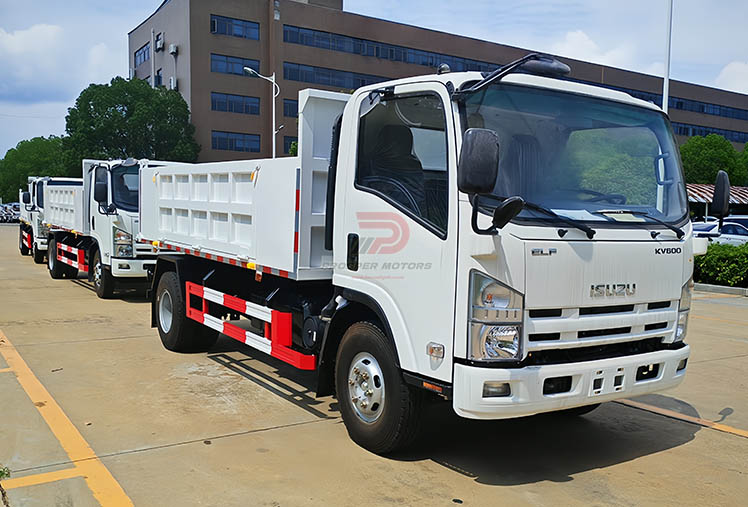
Torque, on the other hand, is the rotational force that gets the isuzu RHD truck vehicle moving. This force originates in the engine but is amplified as it travels through the powertrain. The process, known as torque multiplication, occurs in the transmission and, most critically for our topic, in the final drive or axle. The axle ratio is the key to this final, crucial stage of amplification.
Think of the axle ratio as a lever. A larger ratio (e.g., 5.286) is like using a longer lever—it requires less initial force (from the engine) to move a heavy object (the loaded truck). This "gearing" advantage is what provides the immense twisting force at the wheels needed for low-speed, high-load situations.
Why Axle Ratio is "More" Important for Dump Trucks
Short-haul dump truck applications are literally the direct opposites of long-haul trucking applications with respect to highway drivers. These include construction-site operation with heavy loads, soft ground on construction sites with uneven surfaces, and mountain grades. These all call for extreme wheel torques rather than high speeds.Let's compare two configurations:
"High Power, Small Ratio": In this combination, performance is lacking in adverse weather. Perhaps the engine is quite powerful, but thelow ratio is insufficient for an effective torque multiplication. It will put a lot of work on the clutch, as the rider will need to slip the clutch or shift gears, which will impact efficiency, fuel mileage, and the durability of the drivetrain."Moderate Power, Large Ratio": This configuration excels. The large axle ratio provides superior torque multiplication, allowing the Qingling Isuzu GIGA Tipper truck to start smoothly and pull strongly at low speeds, even with a less powerful engine. This optimal powertrain optimization results in better fuel economy and reduced driver fatigue.
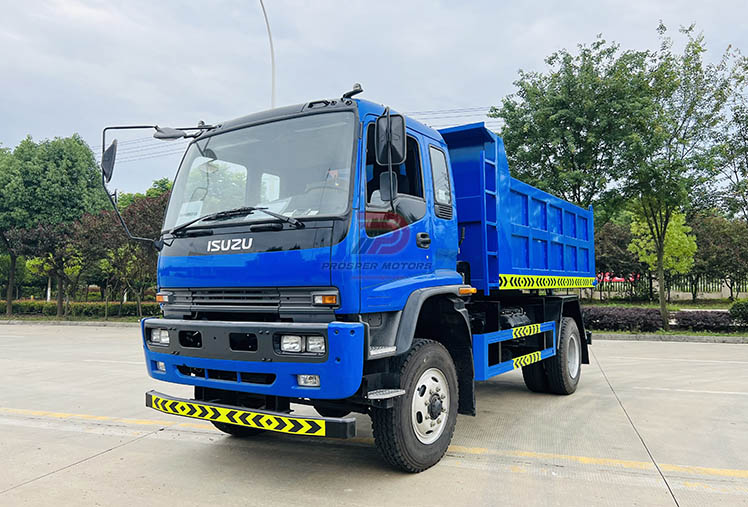
As stated by Michael Evans, a veteran powertrain engineer, "For heavy-duty applications, matching the axle ratio to the job is the first rule of powertrain optimization. An mismatched ratio forces the entire system—engine, clutch, transmission—to work outside its efficiency sweet spot, drastically reducing the vehicle's service life."
From a vehicle engineering perspective, an inappropriate axle ratio introduces shock loads and excessive stress on the transmission, clutch, and driveshafts. This negatively impacts not only vehicle performance and smoothness but also long-term durability.
How to Choose the Right Axle Ratio for Your Dumper Truck
Selecting the correct axle ratio requires a careful analysis of your primary operations. Ask yourself:Terrain: Do you operate primarily in mountainous areas with steep grades or on flat plains and highways?
Load: What is the typical gross Isuzu China electric dump truck weight you will be hauling?
Road Surface: Are you mostly on paved roads or frequently on soft, off-road sites?
When looking at a mining dump quarry dump truck's technical specifications, you'll see axle ratio numbers like 4.875, 5.286, or even higher. The rule is simple: the larger the number, the greater the torque multiplication, but the lower the vehicle's theoretical top speed. A truck with a 5.286 ratio will be a beast on a grade but slower on the highway compared to one with a 4.875 ratio.
Our data shows that fleets operating in mixed conditions can see up to a 8-12% improvement in fuel efficiency by choosing the correct axle ratio. When buying or customizing a vehicle, always provide your sales consultant or a vehicle engineer with the most detailed possible information about your work. That way, they can indeed be competent and effective in proposing a professional configuration that suits your needs.
Conclusion: Embrace Systems Thinking, Move Beyond "Horsepower-Only"
In conclusion, selecting an engine and matching it with the right axle ratio is a matter of systems engineering. They must be considered as a single, integrated unit to achieve a result where 1+1 is greater than 2. Focusing solely on engine power is an outdated and inefficient approach for heavy-duty vehicles.For fleet managers and owner-operators, the final, actionable advice is this: resist the allure of big horsepower numbers. Instead, scientifically, or rather rationally, choose your axle ratio that corresponds to your needs. This is the clue to successfully finding the optimal balance between performance, fuel economy, and durability for your Qingling white dump trucks.
SHARE :

SEARCH
Related Blog
Tags
Garbage Truck Factory Garbage Truck Price Garbage Truck Manufacture Garbage Truck Supplier Garbage Truck Customer Garbage Truck Solution Garbage Truck Commercial Garbage Truck Model Garbage Truck Budget Garbage Truck Used ladder truck quick attack fire truck Fire Engine Fire Truck Fire Pumper Aerial Ladder Hydraulic Tools fire fighting truck price airport fire truck heavy rescue truck
