




How Much Fuel Does a Dump Truck Use Per Day
Dec 26 2025
For all construction, mining, and hauling operations, fuel will always be one of the greatest expenses entailing variability in truck operations. Managing the amount of fuel your dump trucks consume on a daily basis is not just essential in terms of cost-effectiveness; it can significantly improve your business bottom line on a daily basis. The question then is: how much fuel does a dump truck consume?
Understanding Average Dump Truck Fuel Consumption
On an ordinary working day, an ordinary heavy-duty dump truck can use between 25 and 60 gallons (approximately 95 to 227 liters) of diesel fuel. The afore-mentioned figure is wide inasmuch as a precise answer is contingent on many different variables. Fuel usage for a dumpster truck is not a constant but a dynamic figure.Fuel consumption is generally gauged by two methods: miles per gallon in highway usage and gallons per hour in off-road or idle situations. A normal usage rate for a heavy-duty dumper would be between 3 and 6 miles per gallon, but its GPH rate may widely differ depending on its application.
6 Key Factors That Influence Dump Truck Fuel Usage
To accurately estimate your fuel costs, you must consider the specific conditions your fleet operates under. Here are the six most significant factors that impact fuel burn.Truck Size, Engine, and Model
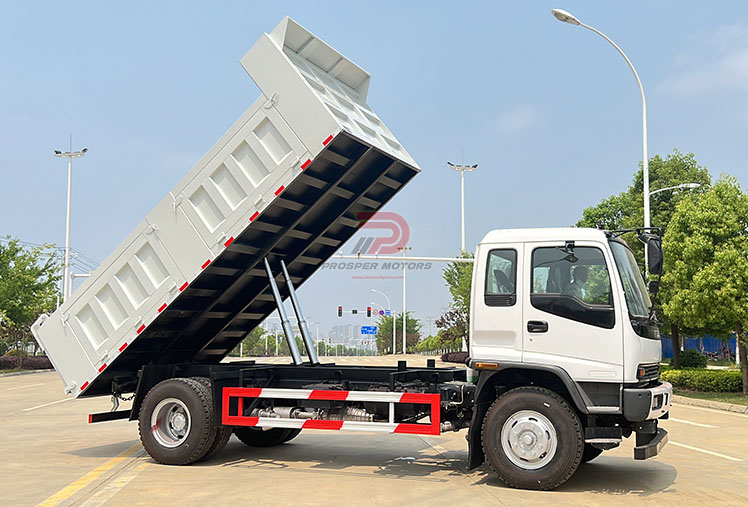
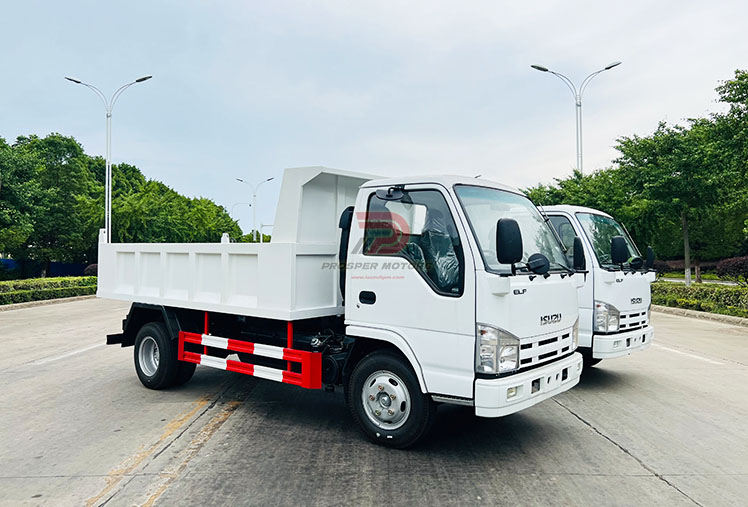
Specifications of the vehicle are the basic source of its fuel consumption. It is only natural that the light-duty dump truck, for example the Isuzu NPR, would consume less fuel compared to the heavy-duty dump lorry like the Isuzu GIGA 8x4 Qingling big dump truck that is designed for larger capacity.The horsepower, displacement, and age of the engine can also play an equally crucial role. A greater and powerful engine will tend to consume higher construction truck diesel to produce torque. Modern trucks tend to implement advanced technology for improved heavy equipment mileage.
Load Weight
The correlation between weight and fuel consumption is direct and brutal with no give. The heavier cargo of material you are carrying—and this might be gravel, sand, or demolition rubble—the harder your engine has to work, and the more fuel you will through.A full truck may suffer a fuel economy penalty of 30-40% compared to when it was empty. A partially loaded truck will certainly burn more fuel compared to when it was empty.
Terrain and Working Conditions
The area in which the truck is running has a phenomenal influence on its fuel meter. It is much more efficient to drive on a highway compared to a muddy construction site.Geographical features with strong inclines cause engines to run at full power, resulting in drastic GPH increments. Rough terrains with features like mud and sand cause increased drag; thus, more throttle is needed in these conditions, leading to a depleted fuel tank.
Idling Time
One of the key hidden fuel cost drivers is idling. A diesel engine can burn 0.8 to 1 gallon of fuel per hour when idling. Waiting for loading, waiting in a dump site queue, or taking a driver break can lead to a considerable accumulation of idling time."Idling is the silent killer of fuel budgets," states, a leading fleet management consultant. "An hour of idling per day on a single tip truck can waste over 200 gallons of fuel annually. Multiply that across a fleet, and the cost becomes staggering."
Operator Behavior
The driver directly controls the fuel pedal. Aggressive drivers who exhibit behaviors such as rapid acceleration, hard braking, and speeding can consume fuel at a rate 30% higher than usual.However, smooth operation, maintaining a steady speed, traffic anticipation, and gear-shifting techniques are key characteristics of a fuel-efficient driver. An investment in driver training programs results in a considerable return through fuel conservation.
Vehicle Maintenance
A well-serviced Isuzu off road truck is a fuel-efficient truck. When routine maintenance is neglected, your bottom line is directly affected. It starts with proper tire pressure to overcome roll resistance, clean air filters for your engine to breathe freely, and maintenance tune-ups for your engine.As reported by the Department of Energy, simply making sure that tires are filled with air can reach fuel economy savings of 3%. A maintenance regimen is integral in managing the cost associated with operating tipper trucks.
How to Calculate Your Fleet's Daily Fuel Consumption
From estimates to actual figures, there has to be tracking involved. This could be done by manual means by logging begin or end mileage and the amount of fuel put in, or accomplished in a better way through current technology.Manual Tracking: When you start your day’s activities, you need to record the current reading from the odometer. After concluding your activities at the end of the day, you will be required to note down the final reading from the odometer in addition to the level of petrol that filled.
Telematics & Fleet Management Software: This is the most precise approach. GPS and engine analysis enable precise miles driven, hours of operation, idling, and fuel consumption information.
Key Formulas:
MPG = Miles Driven / Gallons Used
GPH = Gallons Used / Hours of Operation
5 Practical Tips to Reduce Dump Truck Fuel Costs
Knowledge is power, but action is profit. Use your understanding of isuzu right hand drive dump truck fuel consumption to implement cost-saving strategies.Implement a Strict Anti-Idling Policy: Set clear limits on unnecessary idling (e.g., a 5-minute maximum) and use telematics to monitor compliance.
Optimize Routes: Plan routes to minimize total mileage, avoid steep grades, and bypass areas with heavy traffic congestion.
Ensure Regular Maintenance: Adhere to a strict preventive maintenance schedule, paying close attention to tires, air filters, and engine oil.
Provide Driver Training: Educate and incentivize operators to adopt fuel-efficient driving habits. Reward top performers.
Invest in Modern Technology: When purchasing new vehicles, prioritize fuel-efficient models. Retrofit older electric dumper trucks with telematics to gain visibility and control over fuel usage.
Conclusion
An isuzu 4x4 dump truck's daily fuel needs are not just determined by one factor, but are instead the result of an optimum integration among the truck, its payload, the environment, and the truck's driver. As such, although the topography cannot be altered, the factors involving maintenance, truck operation, and drivers can indeed be controlled. Through concerted fuel tracking and a commitment to optimizing fuel efficiency, you can transform what may be one of the most significant operating costs associated with your trucks into a differentiator among your business competitors.The best way to gain mastery over your fuel budget is to adopt a whole systems strategy that incorporates both advances in technology and a focus upon fuel efficiency optimization by expert drivers.
SHARE :

SEARCH
Related Blog
Tags
Garbage Truck Factory Garbage Truck Price Garbage Truck Manufacture Garbage Truck Supplier Garbage Truck Customer Garbage Truck Solution Garbage Truck Commercial Garbage Truck Model Garbage Truck Budget Garbage Truck Used ladder truck quick attack fire truck Fire Engine Fire Truck Fire Pumper Aerial Ladder Hydraulic Tools fire fighting truck price airport fire truck heavy rescue truck
